Lesson 3. The Message to the Church in Pergamum. An interpretation of the seven messages to the churches from the Book of Revelation (the Revelation of John). Teacher – Dmitriy Leo. Father’s Blessing Church.
“Revelation to the Seven Churches” School. Contents
Lesson 3. The Message to the Church in Pergamum.
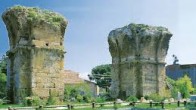
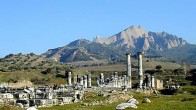
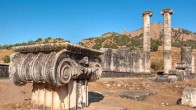
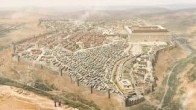
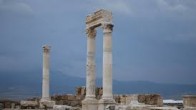
Pergamum – a major pagan center in Asia Minor, a city on a high, cone-shaped hill about 4,000 meters above sea level, between two tributaries of the Caicus River. Pergamum had a temple dedicated to the pagan deity Asclepius – the patron of physicians. Its priests practiced medicine, and an extensive scientific and religious community was established at the temple. The city was a stronghold of idolatry and contained a huge altar to Zeus.
The sanctuary of Asclepius, the god of healing, attracted pilgrims from all over the world. Asclepius was the god of medicine, and his temples were something like hospitals in the ancient world. The city had an extensive library containing more than 200,000 scrolls. The city still exists today, has about 50,000 residents, and is called “Bergama.”
Interestingly, the word parchment comes from Pergamum. For many centuries, ancient scrolls were written on papyrus, a material made from the pith of a large reed growing along the banks of the Nile. The pith was extracted, cut into strips, pressed into sheets, and smoothed.
The result was something like brown wrapping paper, which everyone used for writing. In the second century B.C., a Pergamene king named Eumenes became determined to make his library the largest in the world.
To achieve this, he persuaded the Alexandrian librarian Aristophanes of Byzantium to leave Alexandria and move to Pergamum. In response, the Egyptian king Ptolemy, enraged that his distinguished scholar had been lured away, quickly imprisoned Aristophanes and, as punishment for Eumenes, imposed an embargo on the export of papyrus to Pergamum.
In this situation, the scholars of Pergamum invented parchment, made from smoothed and polished animal hides and cattle skins. As a writing material, parchment was far superior to papyrus and therefore eventually displaced it completely.
Rev. 2:12 And to the angel of the church in Pergamum write: These are the words of Him who has the sharp, double-edged sword:
To the angel. See the previous letters.
“These are the words of Him who has the sharp, double-edged sword.”
Pergamum was the administrative center of Asia Minor; that is, it was the center of the imperial cult for the entire province. Roman rulers were divided into two classes: those who had the right of the sword and those who did not. A ruler with the right of the sword could decide matters of life and death; by his command, a person could be killed on the spot.
Simply put, the proconsul residing in Pergamum had – the right of the sword, and could exercise this right against Christians at any time. People were required, under pain of death, to call Caesar lord rather than Christ.
Therefore, we see here that the final word belongs to the risen Christ, who has the sharp, double-edged sword. (Barclay)
Just as it was believed that the deities in Pergamum gave people health and life and determined their destinies, Jesus speaks these words: “These are the words of the One who truly has authority over life and death.”
Rev. 2:13 I know your works, and where you dwell, where Satan’s throne is. Yet you hold fast to My name and did not deny My faith even in the days when Antipas, My faithful witness, was put to death among you, where Satan dwells.
“You dwell where Satan’s throne is.”
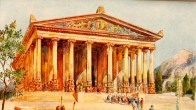
There were three pagan temples there: one dedicated to the chief pagan deity of that time – Zeus; another to Emperor Augustus; and the third – to the deity of healing, the famous Asclepius, the “serpent god” or “healing god.” Incense was burned day and night, and sacrifices were offered on the altars of these three temples.
Crowds of pilgrims came to Pergamum from every part of the known world. Throughout the city, one could see sacrificial feasts and unrestrained pagan banquets, where the flesh was given free rein.
The temple was always crowded with sick people seeking healing through prayer and vigil. Remedies for the sick were revealed in dreams and visions through priests who provided medicines supposedly prescribed to them by the god of healing.
In ancient times, Asclepius was called the “god of Pergamum,” and was honored in the form of a living serpent kept alive in his temple. Coins minted in the same city depicted Asclepius with a staff entwined by a serpent.
This is where the idea originated that a snake coiled around a cup of poison is a symbol of medicine.
“You hold fast to My name and have not denied My faith.”
Society was under the tremendous influence of pagan religion, which determined both weekdays and holidays, as well as every area of life, from sports to family life. The names of pagan deities were heard and glorified everywhere – Zeus, Augustus, and Asclepius. Thousands worshiped them.
The Church in Pergamum, however, honors the one name under heaven by which it itself has been saved and by which all the sinners of the world can be saved, and this name is – Jesus Christ. “...you hold fast to My name” – [krateo] to hold firmly, seize, or hold on to.
The believers in Pergamum proved that it is entirely possible to remain Christians even under such difficult conditions. According to Jesus’ words, the Church can refuse to deny the faith and hold fast through His Name even while in a place that is literally the dwelling place of Satan and his powers. Therefore, if the Church experiences failure in a particular geographic location, this does not necessarily mean that the spiritual atmosphere there is difficult.
“where Satan dwells.”
Pergamum became the center of the satanic system of Babylonian mysteries. This counterfeit religion was based on the claim that it had built a bridge between heaven and earth. The reigning monarch became the head of the system. He had many titles, one of which was “Pontifex Maximus.” “Pont” means bridge, “facio” – I make, and “maximus” – greatest. Thus, combining all these meanings, you get the expression: “The greatest bridge builder” between heaven and earth.
“My faithful witness Antipas was put to death.”
Historians of that time wrote that Antipas was an elder of the Church in Pergamum and had the gift of healing. The city derived substantial income from the sick who flocked to Pergamum by the thousands, where there was a temple of the god of healing – Asclepius. And just as the Apostle Paul nearly died at the hands of the worshipers of the goddess Artemis in Ephesus, so in Pergamum Christ’s faithful witness – Antipas was put to death by the worshipers of Asclepius.
He was burned under Emperor Domitian in the year 93, inside a red-hot bronze bull, because he refused to deny his faith. Not only Antipas but the entire Church in Pergamum remained faithful to Christ to the end of his life.
Jesus does not merely count the churches on earth “by number”; He knows every person in the Church by name, and Antipas’ example shows that Jesus calls him “My faithful witness.” Jesus knows the fate and suffering of every person in the Church.
Rev. 2:14 But I have a few things against you, because you have there those who hold to the teaching of Balaam, who taught Balak to put a stumbling block before the children of Israel, so that they would eat things sacrificed to idols and commit sexual immorality.
“But I have this against you.”
Although the church in Pergamum remains faithful to Christ, it contains error. There are people there who hold to the teaching of Balaam and the heresy of the Nicolaitans. “The teaching of Balaam.” Balaam, according to the general opinion of commentators based on Num. 31:16, advised leading the Israelites through the daughters of Moab into sexual immorality and eating food sacrificed to idols, which was carried out (Num. 22–25; Deut. 25:5; Josh. 24:9).
“Some Christians in the church of Pergamum compromised and adopted many pagan regulations and rituals, calling them sacred and acknowledging them as having divine origin” (Ivanov’s Ancient History, p. 246).
“ate food sacrificed to idols.”
The word [fahein] – means to eat, consume, or taste. The word [eisolofutov] – means sacrificed to idols, offered to idols, or an idol sacrifice. This expression directly refers to ritual or sacrificial food intended as an offering not to God. Jesus says that you have people who teach and persuade My people to eat food sacrificed to idols.
“The Nicolaitans felt they were on solid ground: they associated with pagans, participated in their feasts involving food sacrificed to idols, and tempted wavering Christians by their teaching and example” (“Brussels New Testament 1965”).
Jesus is against the Church mixing with the paganism, customs, and cults of the land in which it exists. Through this, God’s people fall into sexual immorality and eating food sacrificed to idols – this is the teaching of Balaam in the New Testament Church.
Rev. 2:15 So you also have those who hold to the teaching of the Nicolaitans, which I hate.
“So you also have” – (therefore, for this reason) you also have them, as in Ephesus (Rev. 2:6). Apparently, this false teaching had spread everywhere, and the church in Pergamum also fell into it.
“you hate the works of the Nicolaitans.”
According to historians of that time, this heresy was initiated by Nicolas of Antioch, a convert from paganism who was among the first seven deacons of Jerusalem (Acts 6:3–6). Later, he fell away from the true faith and became the founder of the sect of the antinomians. The teaching of the “Nicolaitans” consisted in the doctrine of freedom of the flesh.
The “Nicolaitans” preached freedom of the flesh as a means of mortifying the flesh. The goal was appealing, but the path to achieving it was very dangerous – not fearing the sins of the flesh, because supposedly they could not defile the soul. The “Nicolaitans” taught that the best way to mortify the flesh – was to wear it out and exhaust it through committing the sins of the flesh.
“The Nicolaitans also rejected the dietary law: “The Nicolaitans – a Gnostic sect (that is, one combining elements of Christian faith with pagan and Jewish traditions) in the ancient Christian Church, which rejected the obligation to observe dietary laws and adhered to the teaching that satisfying all the demands of human nature was lawful” (Barclay)
We see that Jesus hates the false teaching of the Nicolaitans, and we need to stay alert so that, instead of putting our flesh to death, we do not please and indulge it by satisfying all our human needs and desires and mixing Christianity with pagan beliefs and traditions.
Rev. 2:16 Repent; or else I will come to you quickly and fight against them with the sword of My mouth.
“Repent”
Jesus gives everyone an opportunity to repent and change the situation. He does not simply come and punish; He gives us a chance and time to set everything right.
“I will fight against them.”
The word [polemeso] means – to wage war, engage in warfare, fight against. Literally, it is translated –“I will wage war against them.”
It should be noted that He says, “I will come and fight against them,” not, “I will come and fight against you.” His wrath is not directed against the entire church, but only against those who cause it to stumble. Jesus offers them the opportunity to repent of this false teaching and abandon it; otherwise, He will come and personally wage war against those who hold to this error.
Some people today experience difficulties and receive no answer for precisely this reason. The Lord Himself is warring against them because they hold to the teaching of the Nicolaitans: they please and indulge their flesh, thinking that this will eventually cause them to stop sinning; they satisfy the human needs and desires of the flesh contrary to Scripture; and they mix Christianity with pagan beliefs and traditions.
Rev. 2:17 He who has an ear (to hear), let him hear what the Spirit says to the churches: To the one who overcomes I will give some of the hidden manna, and I will give him a white stone, and on the stone a new name written, which no one knows except the one who receives it.
“He who has an ear, let him hear what the Spirit says to the churches.”
As we can now see, the word is addressed to everyone who hears it (who has ears to hear), and it applies to many churches, not only to this one. Jesus concludes the message by encouraging those who overcome that they will receive a reward.
Because of the complex symbolism of the promises concerning the future made to “the one who overcomes,” we can only speculate about the possible meaning of these symbols. Thus, we assume that Jesus meant:
“I will give the right to eat the hidden manna.”
This probably refers to heavenly manna.
“The Jews taught that in the time of the Messiah, He would send manna from heaven, and in the age to come manna would become the food of the elect” (“SB 3:793–94 Mounse”).
“In this context, hidden manna denotes appropriate heavenly food, contrasted with the unclean food offered by the followers of Balaam” (“Mounse”).
“A white stone, and on the stone a new name written.”
There are many interpretations of this promise, but we will consider only the most authoritative ones.
1. In the ancient world, so-called tesserae were widely used—small tablets made of wood, metal, or stone, bearing inscriptions. In fact, merely possessing such a tablet indicated that a person had certain rights and privileges. (Barclay)
2. They could be given to participants in games and gladiators as a sign of the public’s admiration, allowing them to abstain from subsequent contests. Perhaps in this context the white stone – is a pass to the Messiah’s banquet. (“Mounse”)
3. In the ancient world, white and black stones were used in court when judges or
juries rendered their verdict: black – meant condemnation, white – acquittal. This means that the Christian
will be justified in God’s sight through the accomplishments of Jesus Christ.4. But there is another interpretation. At that time, it was extremely common to wear amulets and talismans. They were made of precious metals or gemstones, but most often they were simple river pebbles with a sacred name scratched on them. Knowing the name of a god meant having power over him, being able to call on him for help in times of trouble, and ruling over evil spirits and demons.
It was believed that such a talisman was even more effective if no one except its owner knew the name written on it: “which no one knows except the one who receives it.”
End of lesson.
Source: Father’s Blessing Church
Teacher: Dmitriy Leo