Lesson 6. The Message to the Church in Philadelphia. Interpretation of the seven messages to the churches from the Book of Revelation (the Revelation of John). Teacher: Dmitriy Leo. Father’s Blessing Church.
School: “Revelation to the Seven Churches.” Table of Contents
Lesson 6. The Message to the Church in Philadelphia
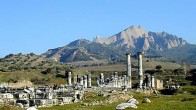
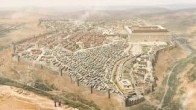
Philadelphia was the youngest of all seven cities. It was founded by colonists from Pergamum during the reign of Attalus II, who ruled Pergamum sometime between 159 and 138 BC. In Greek, Philadelphos means – one who loves his brother. Its founder was Attalus Philadelphus, king of Pergamum, after whom it was named.
The area was highly seismic, and a major earthquake in AD 17 completely destroyed the city. After this disaster, Philadelphia suffered from recurring earthquakes for 20 years. The testimony of Christians continued in Philadelphia throughout the Middle Ages and to this day, despite Muslim invasions.
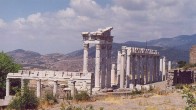
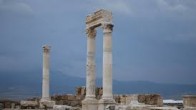
Philadelphia remains a prosperous Christian city with a population of 15,000. The Turks call Philadelphia “Allah-Sher,” meaning “City of God,” corresponding to the words of Revelation: “I will write on him the name of My God and the name of the city of My God” (Rev. 3:12). While everything around it fell, Philadelphia endured and remains to this day, in the words of the enemies of the faith themselves, “a pillar among the ruins.”
The Church in Philadelphia was small in number, and the children of God who made up the Church were materially poor and insignificant in the eyes of the society around them.
Rev. 3:7 And to the angel of the church in Philadelphia write: These things says He who is holy, He who is true, He who has the key of David, He who opens and no one shuts, and shuts and no one opens:
“To the angel.” See the previous messages.
“the one who has the key of David.”
This phrase reminds us of the fulfillment of the prophecy in Isaiah 22:22 and signifies authority over the house of David. Eliakim was appointed overseer of the house of David, and he was given the “keys of David.” Revelation 1:18 says that the risen Jesus has “the keys of Hades and death” and therefore can open the gates of death and lead people into eternal life.
The key of David – is a metaphorical expression denoting complete control over the royal household (Thomas, Mounce, Swete)
Revelation 3:8: I know your works. See, I have set before you an open door, and no one can shut it; for you have little strength, yet you have kept My word and have not denied My name.
“I know your works.”
At first glance, it is not immediately clear what works are being referred to, but the end of the verse describes them: “you have kept My word and have not denied My name.”
“I have set before you an open door.”
“The city was founded for a special purpose – to create a Greek cultural center for spreading Greek culture and language. It was a frontier city located at the crossroads of Mysia, Lydia, and Phrygia, founded to spread Greek culture and the Greek language among the Gentiles living beyond its borders.”
Philadelphia stood on the imperial postal road running from the coast near Troas through Pergamum, Thyatira, and Sardis to Philadelphia, and extending onto the great road leading to Phrygia. Imperial armies and merchant caravans traveled along this road. Thus, it provided an excellent opportunity to spread the Gospel in Greek among different peoples.
Jesus destined Philadelphia to spread His word, and He opened this door for them. This is what happened in the future.
“and no one can shut it.”
In the original text, the conjunction [oti] – that, because appears between the words “it” and “you.” This means that no one can shut this door because...
“you have little strength.”
The church in Philadelphia did not have much power [dunamiv], but it kept the true teaching of Jesus and did not deny His name. The following verse, verse 9, shows that there were circumstances and difficulties opposing them. These were Jews who, at that time, were trying by every means to destroy Christianity.
In the New Testament, power [dunamiv] describes supernatural acts, miracles, and signs. Power [dunamis] went out from Jesus and healed everyone. Jesus gave the disciples [dunamis] to heal diseases, cast out demons, and raise the dead.
Therefore, it may be assumed that the church in Thyatira had less supernatural power, miracles, signs, healings, and so on than, say, the other churches. But unlike the others, it preserved the “purity” of Jesus’ word and the authenticity of the Gospel.
Jesus’ words sound something like this: “I know your deeds. Despite having little strength, you have kept My word and have not denied My name. Therefore, no one will be able to shut the door that I have opened before you.”
Faithfulness to His word and to the name of Jesus will keep the door He opened always open. And so it happened. The testimony of Christians continued in Philadelphia throughout the Middle Ages and to this day, despite the invasion of Muslims. Philadelphia remains a prosperous Christian city to this day.
“You have kept My word.” See below.
“And have not denied My name.”
As history testifies, at that time Christians experienced persecution from Jews, Romans, and pagans –; they were persecuted for the name of Jesus. Some “weak Christians,” out of fear of death or reprisals against their relatives, denied the name of Jesus, thereby saving their own lives. Only Christians who truly believed could refuse to deny the name of Jesus.
Rev. 3:9 Behold, I will make those of the synagogue of Satan, who say they are Jews and are not, but lie—behold, I will make them come and worship before your feet, and know that I have loved you.
“The synagogue of Satan.”
Literally translated, – “the synagogue of Satan.” A synagogue under Satan’s leadership. Satan used the Jews to carry out his destructive plans against the teaching and followers of Jesus Christ. Jesus says that they are lying when they call themselves Jews. Judah [Hebrew: Yehudah] means – “praise of the Lord” in Hebrew. This no longer resembles praise of the Lord. This is no longer a Jew who destroys the One who came from the tribe of Judah –; it is an instrument of Satan.
You can fight for the “purity of doctrine,” for the truth, and at the same time be an instrument in Satan’s hands, through which he actually destroys the truth.
“They will come and worship before your feet.”
This refers to the repentance and conversion of those Jews who persecuted and destroyed the followers of Jesus Christ. Jesus said that He Himself would do this: they would come and worship at your feet and know that I have loved you.
Jews. This designation first appears in 2 Kings in Jeremiah as the name of the people of the Kingdom of Judah; see, for example, 2 Kings 16:6; 25:25; Jeremiah 32:12; 38:19; 40:11; 41:3; 52:28; 44:1. When, after the end of the Kingdom of Israel, the Kingdom of Judah remained the sole representative of the entire people, the name Jew became almost synonymous with Hebrew (Jeremiah 34:9), and the Hebrew language came to be called Jewish (2 Kings 18:26; Nehemiah 13:24).
After the return from exile, the word Jew acquired a broader meaning. The name Jew became the common designation of the newly formed people, partly because the tribe of Judah was numerically predominant among those returning from the Babylonian exile, and partly because the name Judah (see Genesis 49:8ff.) recalled the tribal preeminence of this tribe. By this name, this “people taken as an inheritance” was known to the Gentiles; see Daniel 3:8; Ezra 4:12; Esther 3:4ff.; Tacitus, Histories V.2; Acts 16:20. (Nyström)
That is why Jesus promised the church in Philadelphia that the Jews would “know that I have loved you.”
Revelation 3:10 And because you have kept My word of patience, I also will keep you from the hour of testing that will come upon the whole world, to test those who dwell on the earth.
“And because you have kept My word of patience.”
The word “keep” [etirezas] has two meanings, and we believe that we should consider both;
1. [etireo] – to fulfill, observe, adhere to. Because they steadfastly and patiently adhered to Jesus’ words and stood on the Word, He would keep them from trials. This also helped them stand firm against the attacks of the Jews at a time when they were destroying the teaching and followers of Jesus.
2. [etireo] – to keep, guard, preserve under protection. Because they did not corrupt the truth of Jesus’ words but preserved intact the teaching they had received from the Apostles, He would keep them from trials. That is why Jesus opened the door for them to spread His Word throughout the world in the Greek language.
“I will keep you from the hour of testing.”
Time, hour [peirasmov] – of testing, trials.
“the whole world.”
It literally translates as “the whole inhabited earth.” This does not mean the entire universe and may refer to the territory inhabited by people. It is not about cataclysms affecting nature, but about the testing and temptation of people.
The Church or person who preserves and holds fast to the true word is kept by the Lord from the temptations and trials coming upon the earth.
Rev. 3:11 Behold, I am coming soon; hold fast what you have, so that no one may take your crown.
“Hold fast what you have.”
Jesus calls the Philadelphians to hold fast to what they have, so that no one may take their crown. This does not mean that someone can steal their crown, but that God will take it from them and give it to someone else if they are no longer worthy to wear it. In the Bible, people sometimes lost their position because they were unworthy, and others received it.
Thus, Esau had to give up his position to Jacob (Gen. 25:34; 27:36). Reuben, who raged like water, had to give up his position to Judah (Gen. 49:4, 8). Saul lost his position, which David received (1 Sam. 16:1, 13). Shebna lost his position, which Eliakim later assumed (Isa. 22:15–25). Judas’s position was given to Matthias (Acts 1:25, 26). The Jews lost their position, which the Gentiles received (Rom. 11:11).
Rev. 3:12 The one who conquers, I will make a pillar in the temple of My God, and he shall never go out; and I will write on him the name of My God and the name of the city of My God, the new Jerusalem, which comes down out of heaven from My God, and My new name.
Given the complex symbolism of the promises concerning the future made to “the one who conquers,” we can only speculate about the possible meaning of these symbols. Thus, we suppose that Jesus meant:
“I will make pillars in the temple.”
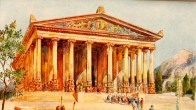
The Greek word [nao] – means temple, sanctuary, or shrine. In the New Testament, it refers to the inner part of the sanctuary containing the Holy Place and the Holy of Holies, not the entire structure comprising the whole temple. Thus, this promise means that the conqueror will hold a permanent, important position in the presence of God Himself.
“And he shall never go out.”
This may be a promise of safety. We have already seen that Philadelphia was threatened for a long time by continuous earthquakes, and at such moments the population fled into open spaces to save themselves, returning hesitantly after the tremors stopped. This is a promise of safety and peace for faithful, conquering Christians in the world that Jesus Christ gives.
From Strabo’s descriptions, it is clear that the tremors occurred daily. Cracks appeared in the walls of houses; one part of the city would lie in ruins, then another. Most of the population lived outside the city in huts and tents, even afraid to go into the streets lest they be killed by collapsing buildings.
Those who nevertheless continued living in the city were considered insane; they had to prop up swaying buildings constantly and periodically flee to open spaces in search of safety.
Those terrible days were not forgotten in Philadelphia, and its inhabitants lived constantly expecting terrifying earthquakes, ready to flee to open spaces in search of safety. A resident of Philadelphia knew well what protection the promise that “he will no longer go out” offered him. (Barclay)
Rev. 3:13 Whoever has an ear, let him hear what the Spirit says to the churches.
As we now see, the word is addressed to everyone who hears it (has ears to hear), and it is intended for many churches, not only this one.
End of lesson.
Source: Father’s Blessing Church
Teacher: Dmitriy Leo