Lesson 7. The Message to the Church in Laodicea. An interpretation of the seven messages to the churches from the Book of Revelation (the Revelation of John). Teacher: Dmitriy Leo. Father’s Blessing Church.
“Revelation to the Seven Churches” School. Table of Contents
Lesson 7. The Message to the Church in Laodicea.
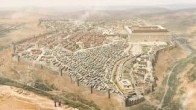
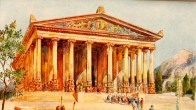
The city of Laodicea was founded by Antiochus II in 261–296 BC and named after his wife, Laodice. The city of Laodicea lay on both sides of the great road leading east; it entered the city through the Ephesian Gate and left through the Syrian Gate. This brought financial prosperity to the city and turned it into one of the centers of banking.
The Lycus Valley produced glossy black wool, which was used to make black clothing and carpets, making the city famous. Laodicea was also a center of medical education and the production of collyrium, a well-known medicinal eye ointment.
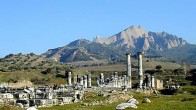
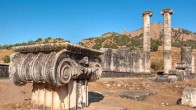
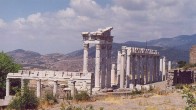
The city was known for its warm, soda-containing springs; from neighboring Hierapolis, the warm springs flowed into the Maeander River. Today, the city of Laodicea exists only as magnificent ruins known as Eski Hisar, bearing witness to its former greatness.
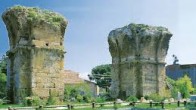
Laodicea was originally a fortress, but it had one very vulnerable point – water entered it from springs through a ten-kilometer-long underground aqueduct – a dangerous situation for a besieged city. In 1009, the city was completely plundered and devastated by the Turks. It was destroyed by the famous conqueror Timur.
By the time the Book of Revelation was written, the Church in Laodicea was already approximately 40 years old.
Rev. 3:14 And to the angel of the Church in Laodicea write: These things says the Amen, the faithful and true Witness, the Beginning of the creation of God:
“To the angel.” See the previous messages.
“Amen”
In Isaiah 65:16, God is called the God of truth, which in Hebrew sounds like [God Amen]. The word “amen” is often placed at the end of a serious statement to guarantee its truthfulness. If God – is the God of Amen, then He can always be relied upon in everything. Jesus said that He was now going to tell them the truth.
“the faithful and true witness.”
He – is the faithful and true witness. One commentary states that a witness must meet two important requirements:
- He must have seen with his own eyes what he is talking about.
- He must be completely honest and accurately repeat what he has heard and seen.
Addressing this church, Jesus says: “I will speak only what I see and know, and nothing more. I will tell you the truth.”
Revelation 3:15 I know your works, that you are neither cold nor hot. I wish you were cold or hot!
“neither cold nor hot.”
This figurative expression was especially meaningful to the believers in Laodicea. Near the city was a waterfall fed by hot springs flowing from Hierapolis. As these hot waters traveled through the Lycus Valley toward Laodicea, a distance of approximately 6 miles, they cooled noticeably and, by the time they reached the vicinity of Laodicea, became nauseatingly lukewarm.
Thus, this unusual geographical feature was known to everyone and perfectly characterized the spiritual condition of the believers in the Laodicean church.
“Oh, that you were cold or hot.”
Laodicea was home to one of the most famous resorts in the Roman Empire, established there because of its excellent healing springs. The hot water from the springs benefited people by strengthening their bodies.
Therefore, hot water was very valuable and medicinal. The climate in Asia Minor (present-day Turkey) is quite warm, and refrigerators did not yet exist, so cold water was one of the main sources of thirst-quenching refreshment for people in homes and bathhouses.
Knowing the characteristics of the hot and cold water in this city, Jesus may have chosen these images to show that the Laodicean Church brought people no benefit – it was neither cold nor hot.
“Oh, that…”
Jesus considers both the cold and hot states to be preferable in this case. This shows that He was speaking specifically by using these characteristics of water as an example.
And most likely He was not speaking about the Christian’s spiritual condition (as is commonly believed), because Jesus could not regard a cold Christian as being in a normal spiritual condition. There is no confirmation of this in Scripture. Moreover, the reason was different, as we will see below in verse 17. The following verse also confirms that the subject was specifically the properties of water.
Revelation 3:16 But because you are lukewarm, and neither hot nor cold, I will spit you out of My mouth.
“Spit out” – to spew out, to spit out.
This is not an error in the text; Jesus uses precisely this word in this passage. Therefore, we do not think that this refers to some mysterious spiritual imagery. First meaning: Jesus gives a simple example involving water: when it is lukewarm, you do not want to drink it.
Second meaning: The water of hot mineral springs often has a nauseating taste and can indeed cause people to vomit. This was precisely the effect the Laodicean Church had on the risen Christ. This is worth considering. (Barclay)
Revelation 3:17 Because you say, “I am rich, have become wealthy, and need nothing,” and do not know that you are wretched, miserable, poor, blind, and naked.
“For you say”.
The word “for” is most often translated – as “since, because.” This word is also connected with the preceding expression: “... I will spit you out of My mouth, because you say that ...”.
This was their greatest problem, because wealth was their chief value – what they talked about, lived for, and took pride in. The Laodiceans spoke about themselves and considered themselves to be ... “I am rich; I have become wealthy.” Literally, “I have become rich,” “I am prospering.”
There was no more prosperous city in Asia Minor than Laodicea. Because Laodicea had banks and resorts that attracted the attention of the country’s wealthiest people, arrogance, self-satisfaction, and debauchery prevailed in the city. Its inhabitants, including the Christians, enjoyed a very high level of material prosperity.
The Laodicean Church not only claims to be rich, but also makes another fatal mistake by asserting that this wealth is the result of its own efforts – “I have become rich,” “I am prospering.”
The city was located in a region to which many Jews had emigrated. The rabbis denounced their congregants who sought the wines and baths of Phrygia. In 62 B.C., the provincial governor Flaccus was so alarmed by the sums of money the Jews were taking out to pay the temple tax, which was paid by all Jewish males, that he banned the export of money. As a result, twenty pounds of gold were confiscated in Laodicea, and one hundred pounds of gold in Apamea, Phrygia, which people had attempted to smuggle out. This gold was worth 15,000 silver drachmas. The Jewish temple tax was half a shekel, or two drachmas. This means that at least seven and a half thousand Jewish males lived in the region. (Barclay)Laodicea was so wealthy that when a major earthquake struck the city in A.D. 60, Laodicea refused the aid offered by the Senate.
“and have need of nothing.”
Or ... I no longer need anything. I have everything, and I need nothing else.
This is what Jesus calls “lukewarmness”: when you are satisfied with material things and no longer need anything. A Laodicean – is a person who is content with his condition and proud of the modest successes he has achieved. It is almost impossible to convince him how much he needs and how far he is from the goal of perfection.
A Church or person who satisfies only themselves, even despite apparent material prosperity, is in a “lukewarm condition.”
Material prosperity is not a sign of God’s encouragement, nor is it a sign of spirituality. In a place such as Laodicea, most of the city’s people were wealthy even without the Church’s help, and this was not a sign of their spirituality.
Revelation 3:18 I counsel you to buy from Me gold refined by fire, so that you may become rich; and white clothes to wear, so that the shame of your nakedness may not be seen; and anoint your eyes with eye salve, so that you may see.
“I advise you to buy from Me.”
Jesus did not reject them but advised them to buy from Him genuine treasures with which they could truly become rich. Jesus was not opposed to their becoming wealthy, but He showed them the way –—from whom they should buy what constitutes true wealth. The rich person is not the one who has earthly riches, but the one who has the riches Jesus gives.
“gold refined by fire.”
Literally – “gold brought out of the fire,” “heated in the fire.” This is a difficult passage to interpret, but it may refer to faith.
“and white garments.”
This was a major textile manufacturing center. The sheep grazing around Laodicea were renowned for their soft, glossy purple-black wool. This wool was used to make a special kind of tunic called trimita, which became so closely associated with the city that it was sometimes even called – Trimitaria.
The garments made there were famous throughout the world, and the wool of Laodicea’s sheep was a luxury item known to everyone. Laodicea was so proud of the garments produced there that it failed to realize it was naked in the eyes of God. The risen Christ urges Laodicea to buy white garments from Him. This may refer to righteousness.
“and anoint your eyes with eye salve.”
Laodicea was home to one of the most famous resorts in the Roman Empire, established there because of its excellent healing springs. The resort’s fame was also enhanced by the presence in Laodicea of a world-renowned medical school, which specialized primarily in treating eye diseases by producing collyrium –, a famous eye salve.
Jesus is literally telling the Laodiceans – that they are blinded by wealth and therefore advising them to use the salve for the blind made in their city so that they may see. Jesus may have been speaking about the Word of God, which opens the eyes.
Revelation 3:19 Those whom I love, I rebuke and discipline. Therefore be earnest and repent.
The Greek word translated “discipline” is often understood only in a harsh sense, such as: “I love you, therefore I will punish you ...,” “... we cannot avoid punishment, since this is how God shows His love toward us ...,” and so on.
This is not quite so, because the Greek word for “to discipline” [paideo] means – teaching, correction, and upbringing.
The Lord teaches us as sons and daughters because He loves us. However sad the spiritual condition of the Laodicean church may be, Christ does not abandon it. He loves it, rebukes it, and wants to set everything right. He calls it to repentance and zeal. They must repent of this sin and be zealous for true riches.
Rev. 3:20 Behold, I stand at the door and knock: if anyone hears My voice and opens the door, I will come in to him and dine with him, and he with Me.
“I stand at the door and knock.”
The door referred to here is under a person's authority, and each person can open or close it at will. “If anyone hears My voice and opens the door” – this statement has two meanings, because the word [akouse], “hears,” – has two meanings: “to hear” and “to obey.”
The first meaning is, “whoever hears His voice and opens the door”; the second is, “whoever obeys His voice and opens the door.” In one case, the reference is to His voice; in the other, to His message.
“I will dine with him.”
The Greek word [deipon] means – dinner, the main meal of the day.
The Greeks ate three times a day. They had:
- akratism, breakfast – a piece of dry bread dipped in wine.
- ariston – lunch; they did not go home for lunch, but had a snack right by the roadside, eating a piece brought with them, or somewhere beneath a colonnade or in a city park; and finally,
- deipnon – dinner, the main meal of the day.
It lasted quite a long time; people did not hurry – the day's work was finished. And it is precisely this deipnon that Christ will share with the person who responds to His knock—not some snack eaten on the run, but a meal during which people engage in friendly conversation. (Barclay)
Rev. 3:21 To the one who overcomes I will grant to sit with Me on My throne, just as I overcame and sat down with My Father on His throne.
In view of the complex symbolism of the promises to “the one who overcomes” concerning the future, we can only suppose the possible meaning of these symbols. Thus, we suppose that Jesus meant: “I will grant to sit with Me on the throne.”
Christ calls the Laodicean Church to overcome its “lukewarm” spiritual condition and promises it, in the event of victory, a place with Him on His throne. In other words, Christ calls the spiritually cold Laodicean Church to rise and, from the depths of its fall, ascend to the highest heights of heavenly glory.
Is this possible? Yes, it is possible, for Christ’s promise says: “To the one who overcomes I will grant to sit with Me on My throne.”
This means sharing the glory of His Kingdom with Christ. (Barclay)
Rev. 3:22 Whoever has an ear, let him hear what the Spirit says to the churches.
As we now see, the word is addressed to everyone who hears it (has ears to hear), and it is intended for many churches, not just this one.
Conclusion
The treasures of the city of Laodicea – money, woolen fabrics, and medicinal ointments – had captured the hearts of the Laodiceans and cooled their love for Christ. But they did not notice the loss of heavenly treasures and looked upon themselves with satisfaction. They were spiritually blind and did not see their spiritual poverty and nakedness.
That is why Christ offers the church in Laodicea His heavenly treasures: “gold refined by fire,” “white garments,” and “eye salve.”
End of lesson.
Source: Father’s Blessing Church
Teacher: Dmitriy Leo