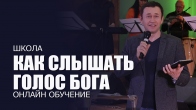
Lesson 1. Hearing the Voice of God. The “How to Hear God” School was held at Father’s Blessing Church. Author: John Paul Jackson. Teacher: Dmitriy Leo
Question 1
If God clearly speaks now in our audience, will we all hear what He has said to us? (The correct answer is no!)
John 12:28–30 “Father, glorify Your name.” Then a voice came from heaven: “I have both glorified it and will glorify it again.” The crowd standing there and hearing it said that it was thunder; others said, “An angel has spoken to Him.” Jesus answered and said, “This voice did not come for My sake, but for your sake.”
We are all constantly hearing something, but few of us are able to hear when, where, and what God is saying. The task is to learn to listen to and hear His voice in many different ways throughout the day. Jesus said:
Matthew 13:9–13 “He who has ears to hear, let him hear! And the disciples came and said to Him, “Why do You speak to them in parables?” He answered them, “Because it has been given to you to know the mysteries of the Kingdom of Heaven, but to them it has not been given. For whoever has, more will be given to him, and he will have abundance; but whoever does not have, even what he has will be taken away from him. Therefore I speak to them in parables, because seeing they do not see, and hearing they do not hear, nor do they understand.”
Jesus said that we have been given the privilege of hearing and understanding the mysteries of God—this is given to disciples, but not to mere bystanders. Moreover, Jesus told us (His disciples):
…for whoever has, more will be given to him, and he will have abundance; but whoever does not have, even what he has will be taken away from him…
Developing the ability to hear God is not merely good; it is extremely important, because if we do not develop our ability to hear, we will eventually lose the ability to hear anything at all.
Prophetic people are not born mature and able to hear everything—they grow in this. For example, it took Samuel 25 years before Israel recognized him as a prophet, Jeremiah 15 years, and Moses 40.
If we do not develop our ability to hear, we will never hear.
Question 2
What do you think needs to be done first of all to begin hearing anything at all? (the correct answer is: draw near to Him)
Matthew 13:1–3 “That same day Jesus went out of the house and sat by the sea. And great crowds gathered around Him, so that He got into a boat and sat down; and the whole crowd stood on the shore. And He taught them many things in parables…”
We will not begin to hear the voice of God if we do not begin coming to Him to listen. Yes, as we grow further, we will walk in Him and hear His voice constantly in many ways, but this will already be the result of intimacy with Him.
It is impossible to hear Him without being with Him. Jesus said, “…My sheep know My voice.” Sheep know the voice of their shepherd because they are near him; they do not know the voices of shepherds who are far away from them.
If we want to hear and recognize His voice specifically, we need to be near Him more often. This is the question that concerns many people: how can we distinguish our own voice or demons from the voice of God? The answer is, “…My sheep know My voice.”
The purpose of our prophetic seminars is to learn to be near Him and to learn to listen to Him in many ways. For the Holy Spirit Himself chooses how to speak to us. And He can not only tell us which store to shop at the next day, but is ready to reveal great mysteries to us from the very depths of God;
1 Corinthians 2:9–11 “But, as it is written: ‘What no eye has seen, nor ear heard, nor the heart of man imagined, what God has prepared for those who love Him’—these things God has revealed to us through the Spirit. For the Spirit searches everything, even the depths of God. For who knows a person’s thoughts except the spirit of that person, which is in him? So also no one comprehends the thoughts of God except the Spirit of God.”
2. The Role of Character and Anointing in Our Prophetic Growth
There are four main groups of people who operate in prophetic gifts.
1. High risk and high anointing – these are gifted and anointed people, but they take great risks by attacking the Body of Christ through their prophecies.
- – they are guided only by their own revelations
- – they do not consider themselves part of a local church, but of the universal Church
- – they formally acknowledge the authority of a pastor over them
- – they do not accept correction from people – only from the Spirit (as they say)
- – they rebuke and attack the church and its leaders through prophecies (they see themselves as a voice from heaven, watchmen on the walls…)
- – they more often wander from church to church than settle in one
2. Low risk and low anointing – these are people who simply think they are prophets, but because they lack gifts and anointing, they only diminish the prophetic gift in the eyes of others; they are not taken seriously.
- – they are always seeing and hearing something (or so they think), and it is always important to them that everyone hears it
- – their revelations are usually conditional, and they skillfully change their meaning if their reputation is called into question
- – they do not care whether what they say comes to pass; what matters to them is being recognized as someone
- – they build their authority on revelations taken from the prophecies of other prophets, books, recordings, and stories
- – their fruit always reveals their immaturity, and their revelations are not taken seriously
3. High Risk and Low Anointing – they attack the Church through their prophecies, but they have no power or anointing.
- – they always know the right direction for the Church and the vision for the pastor (or so they think)
- – they always hear clearly when the entire Church should fast, although they themselves have no intention of doing so
- – they point out the Church’s sins and mistakes while making the same mistakes and committing the same sins themselves
- – they do not bear good fruit in their personal lives; instead, they more often bring rebellion and confusion into the Church
- – when their sins are pointed out to them, they are more likely to attack their opponent than to repent
4. Low Risk and High Anointing – these people belong to the right group. They are truly prophetic people. Their principle is: mercy triumphs over judgment. They encourage the Church and bear strong, mature fruit in everything.
- – they possess many powerful gifts, but they do not hold them up as an example or put them on display
- – they consider themselves part of the Body of Christ (the Church) and therefore do not attack it
- – they are accountable to and obedient to those who are over them
- – they live out and practice what they themselves preach or prophesy
- – they acknowledge and take responsibility for their mistakes, sins, and inaccurate prophecies
So, as we can see, anointing and character affect our prophetic ministry in different ways. We must not place anointing above character. Only our fruit can prove our maturity, significance, and strength.
We can all prophesy, but we are not all prophets. God gives us the gift and anointing, but we must continually develop our character. People who prophesy are not born mature; they mature over time.
Some people are mature but less gifted, while others are more gifted but immature—and the latter are a dangerous group in the Body of Christ. We all need to mature rather than wait for a miracle.
Many have fallen in ministry not because they lacked anointing, but because their character had not been crucified. If we place anointing above character, we are in danger! Immature people who prophesy acknowledge and declare themselves to be prophets, while true prophets are recognized as such by others. The more mature we are, the more people hunger for and trust us.
We must be very diligent in developing our character, and success will be determined by our perseverance.
By the way, people who are diligent at work are diligent in ministry as well. How about going to your workplace tomorrow and talking to your supervisor about you? Then I will know whether you should be entrusted with serious work involving people.
Question 3
Does anointing or character hinder us from hearing God? (the correct answer is character)
- – the more peace we have within us, the easier it is for us to hear the voice of God. Inner peace contributes to revelation.
- – the more and more deeply we study the Scriptures, the more we will hear God. Often, God does not speak because of our incorrect theology. If we are hardheaded, that is a problem with our character, not with God.
The black trio that affects hearing God.
- Money – the lust of the eyes
- The opposite sex – the lust of the flesh
- Glory (power) – the pride of life
If we are deceived, attached to, or have not died to these areas in our lives, we will not be able to grow further. Through these things, sin entered the world!
- Through these things, men and women fell throughout the Bible!
- Through these things, Satan tempted Jesus in the wilderness!
- Through these things, the world is blinded and is heading to hell!
- Through these things, the earth and everything done on it will be burned up!
Review Questions
Do you think God will make an exception for us regarding these things? No!
Do we still want to hear the voice of God?
Are we ready to crucify our desires and habits on the cross?
Is it about the anointing or our character?
3. Homework
Discussion questions:
- When did you first realize that you had heard from God?
- Does your family know about this gift, and how do they understand it?
- What does God give you more often—dreams or insights from Him?
Extracurricular activity:
This exercise is designed to focus your attention on the fact that God the Father speaks to us every hour and every minute. It will help develop your listening skills. You will learn to make a deliberate effort throughout the day to ask God what He is saying, doing, and seeing in everyday situations.
As you learn to listen, you will learn to distinguish your own voice, thoughts, and whims from the voice of God. When we learn to listen to and hear God in small things, we will be able to receive a message from His heart about major issues.
- Watch the game. Which category or letter will the participant choose?
- Watch the ball game. What will happen now—a pass or a run?
- Listen to Christian radio. Can you hear God telling you the title of the next song?
- As you approach a door or answer the phone, try to hear who it is before you find out.
- Before the Sunday service, think about which songs will be performed today.
Reading Assignment
Read Daniel chapters 1–4.
- What kind of life did Daniel live to prepare his heart to hear God?
- How do these verses reflect Daniel’s wisdom? (2:17–18)
- What can happen when you hear God clearly? (2:46–48)
- Do you think these wise men (in Hebrew—the astrologer) really heard correctly from God? (4:6)
- Why was Daniel able to give this advice to the king freely? (4:24)
- Chapter 4 is told in the first person by the king himself, not Daniel. What significance does this have?
End of lesson.
Father’s Blessing Church
Author – John Paul Jackson
Teacher – Dmitriy Leo