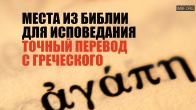
The internet has provided many opportunities for Bible study. There are many different interlinear Bible translations, commentaries, dictionaries, and so on. This has both a good and a bad side.
The good thing is that people can now study the meanings of words and better understand biblical texts. I recommend that everyone who preaches and teaches others conduct a detailed analysis of words. The reason is the enormous responsibility before God that rests on those who teach.
James 3:1 My brothers, do not become teachers, knowing that we will receive a stricter judgment,
The task of a preacher or Bible teacher is to accurately convey the Word of God. And, of course, not to adjust or reshape the Word of God to fit their revelations, but rather to use the Word of God as a tool for testing the quality and validity of any revelation.
I consider it my duty to offer several tips for preachers and teachers who use additional reference materials to study and interpret the Bible.
Nuances in Translating and Interpreting Biblical Texts
Attention! This publication is intended for beginners, and I will not go into depth (hermeneutics, exegesis, linguistics, or morphology), but will explain in simple terms the main mistakes people make when interpreting biblical texts.
1. The meanings of Greek words are not chosen at random.
For example, the meanings of the word:
аγιος (hagios) – holy, consecrated, devout, righteous; as a noun, a holy place;
You cannot simply choose any one of the five meanings of this word that you like and consider it the most accurate translation. This is exactly what some “interpreters” do today, thereby producing heresies. It is necessary to look at what comes before and after the word, and also take into account all the combinations in which this word occurs in the Bible.
For example.
Spirit – implies (hagios) – Holy.
City – implies (hagios) – holy.
Person – implies (hagios) – holy or devout (depending on the context).
“Holy place” is implied (hagios) when the word Lord (a noun in the dative case) follows (hagios).
You may have wondered why I did not use the meaning “righteous” for the word (hagios). The reason is that the Scriptures usually use another Greek word (dikaios) for “righteous.” The word (hagios) is acceptable, but not the best choice for translating “righteous.”
2. It is necessary to take word morphology into account.
The Synodal Translation.
Luke 10:19 Behold, I give you authority to trample on snakes and scorpions, and over all the power of the enemy, and nothing will harm you; An accurate translation, taking morphology into account.
Luke 10:19 Behold, I have given you authority to trample on snakes and scorpions, and – over all the power of the enemy; and nothing will harm you.
You will agree that there is a difference. There are also quite a few words in the Synodal Translation of the Bible that distort the meaning of the entire verse because they were translated in violation of morphology. This is why we launched the project to revise the canonical translation of the Bible.
3. It is necessary to take into account the ways prepositions are used with different cases.
The Synodal Translation.
Acts 1:5 for John baptized with water, but you, after a few days, will be baptized with the Holy Spirit.
Interlinear – machine translation.
Acts 1:5 For John indeed baptized in water, but you will be baptized in the Holy Spirit not many days from now.
Interlinear—a correct translation.
Acts 1:5 For John indeed washed with water, but you will be washed with the Holy Spirit not many days from now.
We will not examine every word now, but will focus on the word “Spirit.”
In the Greek text, the preposition “in” (en) appears with the noun “spirit” (pneyma), and some “interpreters” logically translate this passage as “in the Holy Spirit.” But why, then, do the Synodal and accurate interlinear translations render it “with the Holy Spirit”? Could it be that the translators did not see the preposition “in” (en)?
There is a rule. If a noun in the dative case follows the preposition “in” (en), the word (linking expression) can be declined in several ways.
How? – (if it functions as an instrument) – with the Holy Spirit
Where? – (if it indicates the place of residence) – in the Holy Spirit
To whom? – (case declension) – to the Holy Spirit
Thus, when translating, a choice is made depending on many factors and the context. Since in this passage the Spirit functions as an “instrument” (washed with water, will wash with the Spirit), the accurate translation is “with the Holy Spirit.”
But if this were a verb-and-noun construction—went “to” (en) + Galilee—then, since it refers to “direction,” translating it as “went Galilee” would be a poor choice, while “went to Galilee” would be clear and understandable.
Conclusion
Ancient Greek is very difficult to translate (it is not English). Therefore, I recommend that every preacher and teacher who uses reference materials not limit themselves to a purely logical approach to interpretation, as this will produce many errors and may lead to distortion of the Scriptures and even heresies.
It is necessary to study the grammar of Ancient Greek and use linguistic and exegetical reference materials.
After reading this article, you may say, “This is all so complicated. Why do I need it?” That is a valid question, and it deserves an adequate answer.
The purpose of my article is as follows.
- I want people who interpret Scripture (using interlinear translations and dictionaries) to take into account the many factors that are important when interpreting or choosing the meanings of words. In other words, keep studying—that is good—but approach it seriously and thoroughly.
- If someone says that they looked at the “original” and that the Greek or Hebrew word there means something completely different, and therefore Scripture should be understood differently… this may be a pleasant discovery, but it may also be a distortion of the Word of God. It is important to double-check everything and consider whether this “discovery” contradicts Scripture as a whole and whether the truth is being distorted.
Be blessed!
With love, Dmitriy Leo