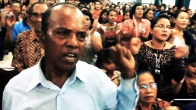
I’m on the plane, very happy to be returning home to Ukraine. And so my crusade in Indonesia has come to an end. It felt as though I had been traveling for an entire year, although the crusade lasted only a month. There were many services, trips, flights and, of course, adventures. Glory to the Lord that He led me and protected me from every evil!
In this concluding article, I will share my observations, impressions and revelations with you. However, this is not the end. A documentary about this crusade will be released soon.
I spent the last few days in Jakarta
I had one service there for the Full Gospel Business Men. It was an interesting audience: company presidents, influential people and major business owners. I felt like a teenager among them because they were all over sixty. When I met the interpreter, he immediately boasted that he had interpreted for Dr. Billy Graham twice. Oh no! After that, I was scared. How would they receive me? In short, they had their own program: someone talked, songs were sung… and I waited, waited and waited. Sitting on the platform, I watched all this and thought, “What am I doing here? I should have slept in the hotel instead.” Then the president said that I had 20 minutes to preach and had to start right away. Oh no! I’m simply “delighted” by meetings like this.
Dear pastors and leaders, if you invite someone to minister in your church, be wise. Give your guests the best time slot if you want them to be effective. Thank the Holy Spirit that He gave me grace! I ministered and prayed for the sick. There were healings, and everyone was happy. But it could have been better.
Here is what I realized. If a church is prepared for a healing service, there will be many healings and miracles. Before this crusade, I had not thought about it, but now this has become one of my highest priorities. I have already been invited to hold another crusade in Indonesia, which is wonderful. By God's grace, many miracles took place during this visit, opening doors for me in Indonesia. But next time, I will not visit places that do not prepare for a miracle service. The Church must be ready “before,” “during” and “after” the service. What do I mean?
How to Prepare a Church for Miracles
1. The Church must be prepared for a healing service so that on the day of the service, people have the maximum level of faith and expectation. When the level of faith is high, many miracles always happen. But it often happens that you have only enough time to prepare people for miracles, leaving no time for the service itself. However, if the leaders prepare the Church, the preacher will be as effective as possible. During this trip, I made comparisons. At the first service, I had to teach the pastors and leaders everything. At the second service, we tried and adjusted our approach. The third service went like clockwork. The hall was packed, everyone knew what to do, and I moved easily in the wave of the Holy Spirit… As a result, the blind see, the deaf hear, the lame walk, and miracles happen! However, in most cases, you participate in only one service and have to build everything as you go. This is acceptable, but not effective.
2. If a church wants to see miracles, it must gather and bring as many seriously ill people, blind people, lame people, and people with disabilities as possible to the service. Many people have internal illnesses, but you will rarely see internal or chronic conditions healed during a service because such healings are discovered much later. But if a church wants to see something happen right during the service, we need to minister to people who have visible symptoms or effects of illness. I have seen prepared churches bring people with disabilities and people from hospitals to every service. Many miracles took place there. Glory to the Lord! Dozens of people rose from their wheelchairs, and various dramatic miracles occurred.
3. Many healings and miracles manifest after services, and it is important to understand this. A church should have a well-prepared, efficient administrative team that records which people came to the service and what illnesses they had. Then, after the service, these people should be called to find out how they are doing. If they are in the process of being healed, they should be encouraged and prayed for. If people have already experienced healing, their testimony should be recorded, and they should be invited to the next service to tell everyone about the miracle.
4. A church should have a team of interviewers who know how to interview people and how to retell their testimonies properly on stage. There are many reasons why this is necessary, but I will not go into the subject in detail now. (I will prepare a special guide on this topic.)
5. There should be a prepared prayer team to help seriously ill people during prayer. For example, a paralyzed person is sitting in the front row. After prayer, they may jump up and walk immediately, or they may get up gradually, making careful movements. Everyone is different, and there is nothing you can do about that. If the preacher spends a long time with each sick person, they will have no time left to help the others. However, if prepared prayer ministers are around the sick, they will come and help them. They will pray, support lame people by the hands, encourage them not to be afraid but to walk more boldly on their own feet, and so on. The main speaker’s task is to release the word and power during the service, as if setting all the mechanisms in motion. Everything else involves spiritual and technical aspects.
I will stop here because this is a broad topic that cannot be covered in a single article. Follow the updates on our website; I will continue sharing revelations received during the crusade.
An Observation Concerning “Tongues”
I noticed that churches where corporate prayer in tongues is practiced are very passionate, unlike those where people do not pray in tongues. This is a very controversial subject. I have changed my opinion on this issue several times myself. However, what I saw “caught” me in the best sense of the word. Sometimes it is difficult to explain something theologically, but you see how it works, and that is all… I came to the conclusion that it is better when the whole church prays aloud in tongues. I know, I know, I know what is written in 1 Corinthians, chapter 14: if there is no interpreter, keep silent. However, I asked the Holy Spirit how it could be that churches praying in tongues do not follow Paul’s instruction, yet still receive good results. I read this epistle several times and noticed something I had not seen before.
Speaking about tongues, Paul uses three different words: “speak” in tongues, “pray” in tongues, and “sing” in tongues. Regarding “speaking,” he instructed them to pray for an interpreter and to speak one at a time. But regarding praying and singing in tongues, Paul said, “I will” “pray” in tongues and “sing” in tongues.
So what should I do? I will pray with my spirit, but I will also pray with my understanding; I will sing with my spirit, but I will also sing with my understanding. (1 Cor. 14:15)
Although “speaking” and “prayer” are similar concepts, Paul distinguished between them. Without going into greater depth, this was enough for me to feel at ease with praying “in tongues”—that is, using both understandable words and other tongues during prayer. I know some people will disagree with me. This is not surprising, because I used to believe that praying in tongues should be done only privately, not during a public gathering. However, I have changed my position today. And, by the way, that same chapter 14 instructs women to remain silent during church services.
…women should remain silent during church services. They are not permitted to speak, but should be submissive, as the Law also says. If they want to learn something, they should ask their own husbands at home, because it is improper for a woman to speak in church. (1 Cor. 14:34–35)
If we consider it normal to allow women to speak during church services, then praying in tongues during church services is normal too. This is the revelation that came to me.
The Peculiarities of Indonesia
If you didn’t know, Jakarta is a city where the roads are always jammed. If you want to test your nerves, welcome to Jakarta. Everyone knows this, but they have resigned themselves to it because there is no other choice. For example, we stopped the car opposite a shopping mall, but we needed to drive closer to park. It took more than an hour, even though the mall was only 200 meters away.
In Jakarta, I was offered a visit to a barbershop. I was pleasantly surprised by the service there. First, women cut women’s hair, and men cut men’s hair. Second, they give you drinking water for free. Third, after the haircut, they massage your head, neck, and shoulders. Finally, they wipe your face and neck with a warm, wet towel. Wow! You get up from the chair feeling refreshed and rested. I hope someone takes note of this and… makes a fortune.
Did you know that dyeing one’s hair is not fashionable in Indonesia? During my entire time there, I saw only a few women with dyed hair, and even they were tourists. Indonesian women have black or dark-brown hair, and they do not worry about coloring it. Although they dream of having white skin.
Did you know that it is very difficult to determine Indonesians’ ages? They are all short and slender. Among them, we looked like Gullivers. You look at someone and think, “A teenager,” then find out they are 30. Conversely, you see a woman who looks about 40, and then discover she is 60.
The island of Kalimantan is wilder than Java. As doctors say, parasites are everywhere in Kalimantan. I thank God that He protected me from adventures of that kind. Once, Darrell picked up some kind of stick in a café, and it literally “knocked him out” during the service. He was hospitalized straight from the stage and then resuscitated at the hospital.
It’s true—I saw for myself how unsanitary everything was there. For civilized people, it is a daily shock. With the same hands they wash their bottoms and wash your forks and plates in dirty water; they wipe tables with dirty rags and then, without washing their hands, put ice into your glass… Oh no! Once I learned this, everywhere I asked, “No ice for me, please!”
The toilets in Kalimantan are not for fans of “white collars” and “handkerchiefs.” A one-meter-by-one-meter room, a concrete floor, a hole in the middle, a water container, and a dipper. Everyone goes in, does their business, and then flushes everything away with water. As a result, there are often puddles on the floor—or the floor is completely covered with water. You may say, “So what’s unusual about that?” The thing is, they use these toilets barefoot. Once I told the hosts, “There’s water standing in the toilet, and it isn’t draining.” They calmly replied, “Nothing serious! Take off your socks, roll up your trousers, and don’t get wet.” My mind went into a storm. What? Roll up my trousers? No amount of money would get me to wade barefoot into that swamp! I asked my translator to explain how to use the toilet. The translator rolled up his trousers and… walked into the toilet with a smile. Apparently, this is normal for them. Horrifying!
It’s a good thing I didn’t go to the other islands, where I would have had to canoe down a river teeming with crocodiles, sleep in a bamboo hut in the jungle, and eat reptiles. It’s a good thing I’m not an adrenaline junkie, or I would have been swept away by the adventures. On this trip, I received a deep revelation that I’m not ready for missionary work in the wildest places on earth. It’s not for me. I prefer civilized ministries.
In conclusion…
But in fact, it wasn’t all that grim, and I had a wonderful time in Indonesia. I saw many miracles, visited many churches, met many interesting people, and gained valuable experience. I am very grateful to Darrell Stott, who helped me on this crusade, doing everything possible to make things as good as possible for me. May the Lord richly reward him! I got to know Darrell much better on this trip. He has a big heart, and he is a great servant.
That’s all. I bless you all! God has opened the whole world before us. God has given us a word for this world. What will we do with it now?
To conclude, here is a little Indonesian worship.
← Previous article: 10.06.2015 – Dmitriy Leo’s Crusade in Indonesia